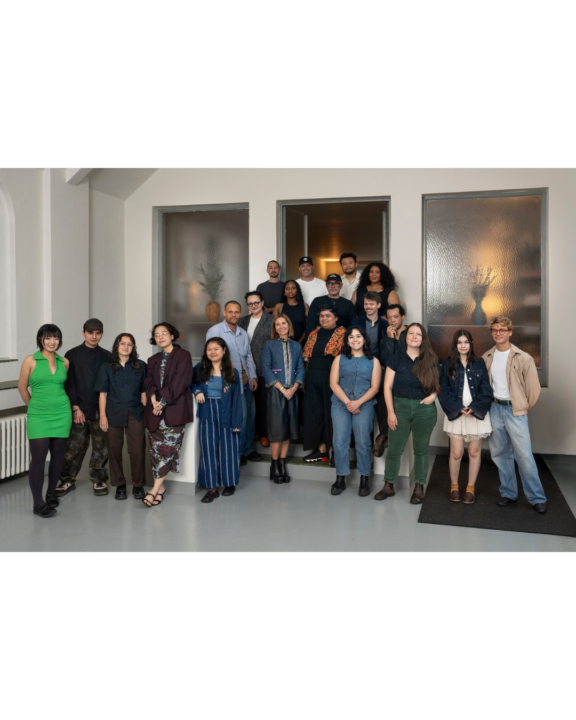
Gilbert Fellows of Classes 2027 and 2028 with Jennifer Gilbert and Brandon Little, Fall 2026. Photo by PD Rearick.
Fellowships
Fellowships
Gilbert Fellows
Since 2021, up to 10 Gilbert Fellows have been named each year, each receiving a full-tuition fellowship to pursue their studies at the Academy.
The fellowships are part of a $30 million gift from the Gilbert Family Foundation given to Cranbrook Academy of Art in 2021 to accelerate the school’s efforts surrounding diversity, equity, and inclusion.
Students are considered for a Gilbert Fellowship in Studio and Critical Studies at the time of their application. They must submit a writing sample in response to one of four prompts on the application. The writing sample should be between 3-5 pages in length. In all cases, the students would likely not have been able to pursue their MFA and MArch without this assistance.
Learn more about each of our current Gilbert Fellows below.
Gilbert Fellows - Classes of 2027 and 2028
Michelle Ali (Ceramics 2028)
Michelle ‘Misha’ Oraa Ali makes art with, inspired by, and critical of science and technology. They graduated magna cum laude from Mount Holyoke College, where they studied Neuroscience and Behavior, and Graphic Narrative and Visual Storytelling. They then worked in psycholinguistics research at MIT and Harvard before obtaining a Master of
Science degree in Cognitive Science from Brown University.
In their practice, Misha combines ceramics with glass and physical computing to create sculptural objects and functional art – ranging from illustrated vessels to species-specific coral forms. They situate their art as a commentary on, critique of, and homage to scientific progress, and the cultures, peoples, and technologies it creates, perpetuates and destroys.
Misha’s work has been exhibited across India, the USA, Turkey, Italy and Scotland, at venues such as the Watershed Center for Ceramics, University of St Andrews, Museo d’Arte di Chianciano Terme, Izmir Bienal and the Experimental Art Gallery in New Delhi, among others.
At Cranbrook, they plan to make critically engaged art which challenges the perceived distinctions between art and science. While drawing from their mixed heritage as a Filipino-Indian immigrant, they aim to dissolve the distinction between ‘studio’ and ‘lab’ through making work at scale with unabashed creative vigor and careful scientific rigor.
Michelle ‘Misha’ Oraa Ali makes art with, inspired by, and critical of science and technology. They graduated magna cum laude from Mount Holyoke College, where they studied Neuroscience and Behavior, and Graphic Narrative and Visual Storytelling. They then worked in psycholinguistics research at MIT and Harvard before obtaining a Master of
Science degree in Cognitive Science from Brown University.
In their practice, Misha combines ceramics with glass and physical computing to create sculptural objects and functional art – ranging from illustrated vessels to species-specific coral forms. They situate their art as a commentary on, critique of, and homage to scientific progress, and the cultures, peoples, and technologies it creates, perpetuates and destroys.
Misha’s work has been exhibited across India, the USA, Turkey, Italy and Scotland, at venues such as the Watershed Center for Ceramics, University of St Andrews, Museo d’Arte di Chianciano Terme, Izmir Bienal and the Experimental Art Gallery in New Delhi, among others.
At Cranbrook, they plan to make critically engaged art which challenges the perceived distinctions between art and science. While drawing from their mixed heritage as a Filipino-Indian immigrant, they aim to dissolve the distinction between ‘studio’ and ‘lab’ through making work at scale with unabashed creative vigor and careful scientific rigor.
Paul Bhajjan (Painting 2028)
Paul Bhajjan is an American painter who began his studio practice in 2017 while pursuing a BA in Film Production at Minnesota State University Moorhead. Private collections across the US and the Netherlands represent Bhajjan’s paintings. His work explores themes of displacement, home as a non-physical construct, the limitations of the physical home as a place of refuge, and the fragility of decorative and non-essential items that often closely represent an individual’s personal identity.
Bhajjan works within a representational painting tradition and intends to utilize his time at Cranbrook to broaden his visual language and artistic process.
Paul Bhajjan is an American painter who began his studio practice in 2017 while pursuing a BA in Film Production at Minnesota State University Moorhead. Private collections across the US and the Netherlands represent Bhajjan’s paintings. His work explores themes of displacement, home as a non-physical construct, the limitations of the physical home as a place of refuge, and the fragility of decorative and non-essential items that often closely represent an individual’s personal identity.
Bhajjan works within a representational painting tradition and intends to utilize his time at Cranbrook to broaden his visual language and artistic process.
Kaleigh Blevins (Painting 2027)

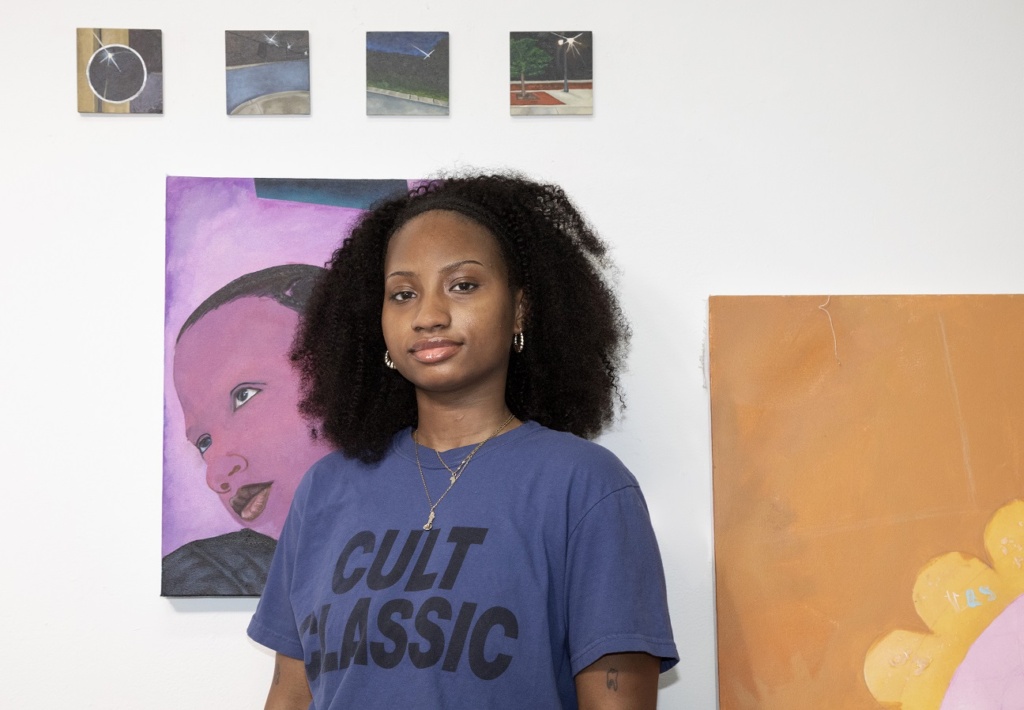
Kaleigh Blevins in their Cranbrook studio, 2026. Photo by PD Rearick.
Kaleigh Blevins received her BFA in Painting from Wayne State University in 2022. Based in Detroit, her work examines how Black identity is shaped in America and the effects of this experience. In her work, familiar images are distorted to illustrate the state of uncertainty and isolation many Black people exist in. Her work has been exhibited across Metro Detroit

Kaleigh Blevins in their Cranbrook studio, 2026. Photo by PD Rearick.
Kaleigh Blevins received her BFA in Painting from Wayne State University in 2022. Based in Detroit, her work examines how Black identity is shaped in America and the effects of this experience. In her work, familiar images are distorted to illustrate the state of uncertainty and isolation many Black people exist in. Her work has been exhibited across Metro Detroit
Rey Carlson (Graphic Design 2027)
Rey Carlson is a Chinese designer, visual artist, and writer from Arlington, Virginia. They received their BFA in Graphic Design from VCUarts and studied at SRISA in Florence, Italy.
Their work often explores subjects such as queerness as refuge, Chinese mythology and storytelling, and personal and cultural loss. They investigate themes that center queer alchemy as interpersonal healing, intentional generosity > output, and always taking your shoes off at the door. In their work, this materializes as printed documentation of cultural objects and stories for larger audiences.
Rey has designed at WeShouldDoItAll and A—B Partners and is part of OTHER PUBLISHING, a queer and trans Asian small format publisher. Their books have been sold at stores around the world, including Printed Matter, Wing on Wo & Co., Ooga Booga, XXXI, After 8 Books, and Wolfman Books, and are available at the New York Public Library. They have designed for and with clients such as Nontsikelelo Mutiti, Penguin Random House, Studio Museum in Harlem, the Museum of the City of New York, and have won a Reed Award and an ADC Award for their branding and video work. Their work has been shown at Printed Matter’s NYABF, LAABF, BKABF, Something Special Studios, Precog Magazine, and Video Snack 7. They have performed readings at Nowadays NYC, BKABF, among others.
Rey Carlson is a Chinese designer, visual artist, and writer from Arlington, Virginia. They received their BFA in Graphic Design from VCUarts and studied at SRISA in Florence, Italy.
Their work often explores subjects such as queerness as refuge, Chinese mythology and storytelling, and personal and cultural loss. They investigate themes that center queer alchemy as interpersonal healing, intentional generosity > output, and always taking your shoes off at the door. In their work, this materializes as printed documentation of cultural objects and stories for larger audiences.
Rey has designed at WeShouldDoItAll and A—B Partners and is part of OTHER PUBLISHING, a queer and trans Asian small format publisher. Their books have been sold at stores around the world, including Printed Matter, Wing on Wo & Co., Ooga Booga, XXXI, After 8 Books, and Wolfman Books, and are available at the New York Public Library. They have designed for and with clients such as Nontsikelelo Mutiti, Penguin Random House, Studio Museum in Harlem, the Museum of the City of New York, and have won a Reed Award and an ADC Award for their branding and video work. Their work has been shown at Printed Matter’s NYABF, LAABF, BKABF, Something Special Studios, Precog Magazine, and Video Snack 7. They have performed readings at Nowadays NYC, BKABF, among others.
Dominik Cunningham (Metalsmithing 2028)
Dominik Cunningham (b. 1998) received a BA (Hons) degree from the College of Central Saint Martins in Jewellery Design in 2022. Upon his graduation, he was honored with the Swarovski Foundation Scholarship, the Theo Fennell Award for Best Design, and the Marzee Graduate Prize.
Cunninham’s practice explores personal and collective identity through his experiences. His work operates
at the intersection of the spiritual, political, and theoretical, using the intimate medium of jewelry to interpret and express how he perceives the world.
Cunningham recently had his first solo show at Galerie Marzee in Nijmegen, Netherlands. He has participated in group shows and artist residencies including a group exhibition at the Weiss über den Tod hinaus in Munich, Germany, and the Françoise van den Bosch Residency in Amsterdam, Netherlands.
Dominik Cunningham (b. 1998) received a BA (Hons) degree from the College of Central Saint Martins in Jewellery Design in 2022. Upon his graduation, he was honored with the Swarovski Foundation Scholarship, the Theo Fennell Award for Best Design, and the Marzee Graduate Prize.
Cunninham’s practice explores personal and collective identity through his experiences. His work operates
at the intersection of the spiritual, political, and theoretical, using the intimate medium of jewelry to interpret and express how he perceives the world.
Cunningham recently had his first solo show at Galerie Marzee in Nijmegen, Netherlands. He has participated in group shows and artist residencies including a group exhibition at the Weiss über den Tod hinaus in Munich, Germany, and the Françoise van den Bosch Residency in Amsterdam, Netherlands.
Michael Finch (Sculpture 2027)

Michael Finch in his Cranbrook studio, 2026. Photo by PD Rearick.
Michael Nguyen Finch earned his Bachelor of Arts in Studio Arts, Summa Cum Laude, from Hamline University in 2024. As a sculptor and interdisciplinary artist, he explores heritage—specifically his Vietnamese ancestry—through a contemporary lens shaped by the intersections of Eastern and Western traditions. By reimagining ancient motifs and classical themes, he examines cultural abstraction, immigration, and identity.
Finch’s practice incorporates steel, stucco, and upcycled cardboard, materials that reflect shelter, transience, and cultural hybridity. His work has been exhibited at Temple at Gallery 120, Dragon in The West at Soeffker Gallery, and American Tragedy at Karlander Gallery. His public sculptures have been featured in the Springfield Sculpture Walk, Price Sculpture Forest, and Hamline Midway Park.
At Cranbrook, Finch aims to refine his technical skills, expand his conceptual frameworks, and deepen his understanding of sculpture’s histories and evolving futures. He will create work that critically engages with identity, materiality, and cultural narratives while contributing to contemporary artistic discourse.

Michael Finch in his Cranbrook studio, 2026. Photo by PD Rearick.
Michael Nguyen Finch earned his Bachelor of Arts in Studio Arts, Summa Cum Laude, from Hamline University in 2024. As a sculptor and interdisciplinary artist, he explores heritage—specifically his Vietnamese ancestry—through a contemporary lens shaped by the intersections of Eastern and Western traditions. By reimagining ancient motifs and classical themes, he examines cultural abstraction, immigration, and identity.
Finch’s practice incorporates steel, stucco, and upcycled cardboard, materials that reflect shelter, transience, and cultural hybridity. His work has been exhibited at Temple at Gallery 120, Dragon in The West at Soeffker Gallery, and American Tragedy at Karlander Gallery. His public sculptures have been featured in the Springfield Sculpture Walk, Price Sculpture Forest, and Hamline Midway Park.
At Cranbrook, Finch aims to refine his technical skills, expand his conceptual frameworks, and deepen his understanding of sculpture’s histories and evolving futures. He will create work that critically engages with identity, materiality, and cultural narratives while contributing to contemporary artistic discourse.
Alberto García de la Puente (Sculpture 2028)
Alberto García de la Puente holds a Bachelor’s degree in Architecture and Fine Arts from Hobart and William Smith Colleges in New York, graduating Magna Cum Laude with Honors in Fine Arts. He completed abroad exchange semesters in Rome, Italy (2023) and at Yonsei University in Seoul, South Korea (2024). He has been based in Guanacaste, Costa Rica since 2012.
His work received the Provenzano Award for Printmaking Excellence, the Faculty Award for Architecture, and the Arthur Dove Award for Painting, with acquisition of work into the College’s permanent collection. Most recently, he was awarded the Tidal Shift Award and exhibited at the Portland Museum of Art in Maine.
His practice contrasts play and estrangement, innocence and the macabre, emphasizing the absence of the child. García de la Puente believes artmaking metabolizes experience through craft and the personification of material. Through repetitive craft techniques such as beading, weaving, and crochet, he embodies memory and trauma, turning patterns and meticulous labor into a language of resilience.
At Cranbrook, García de la Puente will expand his ongoing body of work Mourning Mourning, spanning sculpture, printmaking, installation, architecture, and design, often transforming secondhand childhood toys into material narratives.
Alberto García de la Puente holds a Bachelor’s degree in Architecture and Fine Arts from Hobart and William Smith Colleges in New York, graduating Magna Cum Laude with Honors in Fine Arts. He completed abroad exchange semesters in Rome, Italy (2023) and at Yonsei University in Seoul, South Korea (2024). He has been based in Guanacaste, Costa Rica since 2012.
His work received the Provenzano Award for Printmaking Excellence, the Faculty Award for Architecture, and the Arthur Dove Award for Painting, with acquisition of work into the College’s permanent collection. Most recently, he was awarded the Tidal Shift Award and exhibited at the Portland Museum of Art in Maine.
His practice contrasts play and estrangement, innocence and the macabre, emphasizing the absence of the child. García de la Puente believes artmaking metabolizes experience through craft and the personification of material. Through repetitive craft techniques such as beading, weaving, and crochet, he embodies memory and trauma, turning patterns and meticulous labor into a language of resilience.
At Cranbrook, García de la Puente will expand his ongoing body of work Mourning Mourning, spanning sculpture, printmaking, installation, architecture, and design, often transforming secondhand childhood toys into material narratives.
Pavonis Giron (Metalsmithing 2027)

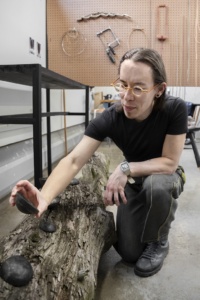
Pavonis Giron in their Cranbrook studio, 2026. Photo by PD Rearick.
Pavonis Giron is a fine artist, author, and illustrator hailing from the Mojave Desert of Southern California. They hold a BFA from the University of Wisconsin-Milwaukee, where their studies focused on sculpture and metalsmithing under Glenn Williams and Yevgeniya Kaganovich.
To deepen their understanding of the metalsmithing craft, Giron attended workshops at Penland and Haystack Mountain School of Craft, led by Tim McCregit and Myra Mimlitsch-Gray (MFA Metalsmithing 1986).
Their sculptural and jewelry-focused work has been shown at regional and national group shows including the 2024 Museum of Wisconsin Art’s Wisconsin Biennial, Queerphoria’s 2023 NYC Jewelry Week exhibition, Tooth + Nail Gallery’s 2025 Facets, and Pump House’s 2026 Texture. Represented by Root Literary, their published works include a children’s picture book, A Rainbow in Brown, Angel Draws A Dinosaur, and a 2026 publication through Macmillian Publishers.
As an openly gay artist of Hispanic heritage, discussions of identity in the context of societal relationships create a backdrop for Giron’s work. Interpreted through a paleontological lens, Giron seeks to understand mores and navigate philosophical concerns through visual motifs, materials, and creative methods that invoke artifacts and geological processes. In their studio practice, they routinely seek conversations with and through their chosen materials, often leaning into found and reclaimed components such as adobe clay, local stone, and hand-processed fiber, which Giron believes to be ingrained with inherent meaning. Giron will continue these efforts at Cranbrook, allowing for a deepened understanding of and literacy with native and recycled materials, melded with metals in the context of contemporary adornment and art objects.

Pavonis Giron in their Cranbrook studio, 2026. Photo by PD Rearick.
Pavonis Giron is a fine artist, author, and illustrator hailing from the Mojave Desert of Southern California. They hold a BFA from the University of Wisconsin-Milwaukee, where their studies focused on sculpture and metalsmithing under Glenn Williams and Yevgeniya Kaganovich.
To deepen their understanding of the metalsmithing craft, Giron attended workshops at Penland and Haystack Mountain School of Craft, led by Tim McCregit and Myra Mimlitsch-Gray (MFA Metalsmithing 1986).
Their sculptural and jewelry-focused work has been shown at regional and national group shows including the 2024 Museum of Wisconsin Art’s Wisconsin Biennial, Queerphoria’s 2023 NYC Jewelry Week exhibition, Tooth + Nail Gallery’s 2025 Facets, and Pump House’s 2026 Texture. Represented by Root Literary, their published works include a children’s picture book, A Rainbow in Brown, Angel Draws A Dinosaur, and a 2026 publication through Macmillian Publishers.
As an openly gay artist of Hispanic heritage, discussions of identity in the context of societal relationships create a backdrop for Giron’s work. Interpreted through a paleontological lens, Giron seeks to understand mores and navigate philosophical concerns through visual motifs, materials, and creative methods that invoke artifacts and geological processes. In their studio practice, they routinely seek conversations with and through their chosen materials, often leaning into found and reclaimed components such as adobe clay, local stone, and hand-processed fiber, which Giron believes to be ingrained with inherent meaning. Giron will continue these efforts at Cranbrook, allowing for a deepened understanding of and literacy with native and recycled materials, melded with metals in the context of contemporary adornment and art objects.
Any Guelman (Ceramics 2027)
Any Guelmann earned a B.Arch. in Architecture and Urban Planning from Pontifícia Universidade Católica do Paraná, Brazil, in 2001. Over time, she deepened her artistic fluency through the study of documentary photography, metalsmithing, and a range of traditional craft disciplines. Before entering Cranbrook, she pursued her ceramics education independently.
Since turning to clay full-time in 2017, Any has spoken at leading conferences, completed residencies, exhibited in both juried and invitational shows, and written about ceramics. Championing access to wood-firing, she created Flash & Ash, the first crowdsourced directory of wood kilns, and served six years on the board of the Washington Clay Arts Association.
Any’s work, like herself, is at the same time rooted and reaching. Born into a conservative Jewish-Brazilian minority and growing up immersed in the dominant African and Catholic cultures of Brazil, and now living between two nations and two languages as a new American citizen, she is comfortable with both dissonance and convergence. In the studio, these incongruous concepts are embodied in the merging of metal and clay, combining ceramic surfaces matured in wood firings with water-cast metal elements. Her vessels stand alone or in groups, seeking assurance that one can, in the same breath, affirm agency and reconcile with mooring.
At Cranbrook, she intends to draw on the academy’s latitude for interdisciplinary exploration to weave her love of diverse materials and techniques into an expanded clay practice.
Any Guelmann earned a B.Arch. in Architecture and Urban Planning from Pontifícia Universidade Católica do Paraná, Brazil, in 2001. Over time, she deepened her artistic fluency through the study of documentary photography, metalsmithing, and a range of traditional craft disciplines. Before entering Cranbrook, she pursued her ceramics education independently.
Since turning to clay full-time in 2017, Any has spoken at leading conferences, completed residencies, exhibited in both juried and invitational shows, and written about ceramics. Championing access to wood-firing, she created Flash & Ash, the first crowdsourced directory of wood kilns, and served six years on the board of the Washington Clay Arts Association.
Any’s work, like herself, is at the same time rooted and reaching. Born into a conservative Jewish-Brazilian minority and growing up immersed in the dominant African and Catholic cultures of Brazil, and now living between two nations and two languages as a new American citizen, she is comfortable with both dissonance and convergence. In the studio, these incongruous concepts are embodied in the merging of metal and clay, combining ceramic surfaces matured in wood firings with water-cast metal elements. Her vessels stand alone or in groups, seeking assurance that one can, in the same breath, affirm agency and reconcile with mooring.
At Cranbrook, she intends to draw on the academy’s latitude for interdisciplinary exploration to weave her love of diverse materials and techniques into an expanded clay practice.
Ji Weon Han (Sculpture 2028)
Ji Weon Han received her BFA in Sculpture from Hongik University in Seoul, with a minor in Ceramics and Glass. She has been actively engaged in exhibition-making and collaborative projects, and has held leadership roles within her department, contributing to the organization of student exhibitions and programs.
Han’s practice centers on sculpture and installation, exploring themes of migration, displacement, and gaps within personal and institutional memory. Drawing from her experience of moving across multiple cities and navigating fragmented records, she develops material-based works that translate absence, repetition, and instability into physical form.
Through the use of materials such as plaster, glass, and industrial substances, her work investigates the tension between fragility and structure, often embodying states that are incomplete, suspended, or unable to fully resolve. Han aims to expand her practice toward broader social and spatial contexts, engaging with questions of mobility, identity, and the systems that shape belonging.
Ji Weon Han received her BFA in Sculpture from Hongik University in Seoul, with a minor in Ceramics and Glass. She has been actively engaged in exhibition-making and collaborative projects, and has held leadership roles within her department, contributing to the organization of student exhibitions and programs.
Han’s practice centers on sculpture and installation, exploring themes of migration, displacement, and gaps within personal and institutional memory. Drawing from her experience of moving across multiple cities and navigating fragmented records, she develops material-based works that translate absence, repetition, and instability into physical form.
Through the use of materials such as plaster, glass, and industrial substances, her work investigates the tension between fragility and structure, often embodying states that are incomplete, suspended, or unable to fully resolve. Han aims to expand her practice toward broader social and spatial contexts, engaging with questions of mobility, identity, and the systems that shape belonging.
Ruth (Xu) Huang (Sculpture 2027)

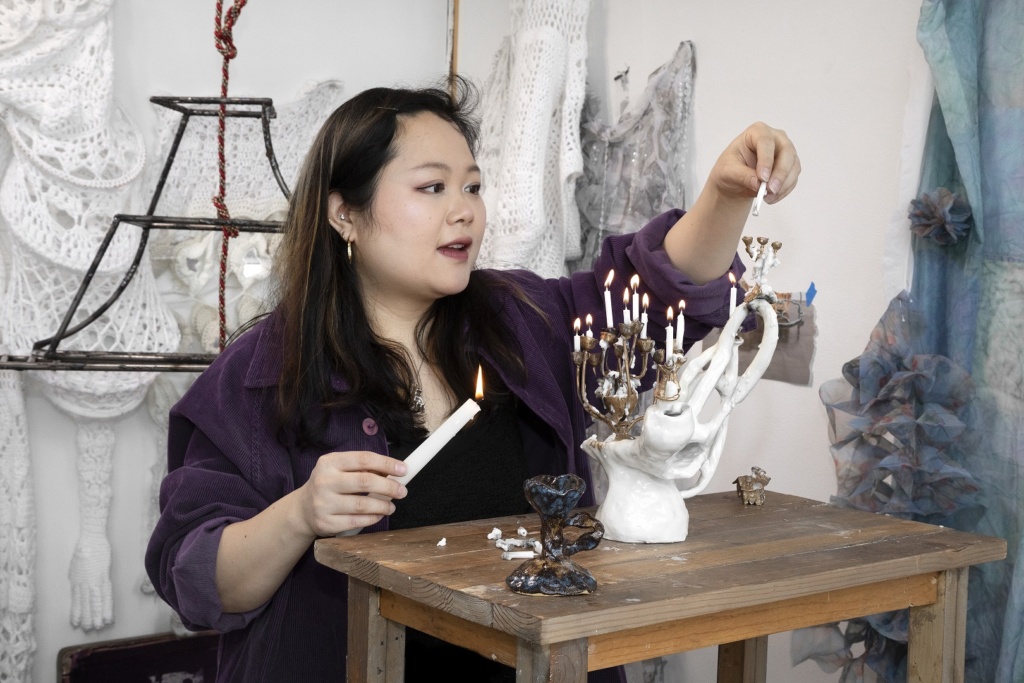
Ruth (Xu) Huang (Sculpture 2027) in her Cranbrook studio, 2026. Photo by PD Rearick.
Ruth (Xu) Huang is an MFA Candidate at Cranbrook Academy of Art and holds a BFA in Fiber with minors in Experimental Fashion and Film & Video from the Maryland Institute College of Art. Her work revolves around grief and loss, responding to the ephemeral nature of life. She explores these themes by reinterpreting rituals and traditional folk religious practices from Southeast Asia and China with the medium of textiles, sculptures, wearables,
moving images, and drawings.
Huang has participated in prestigious artist residencies and programs, including the Yale School of Art Norfolk Program, the Penland School of Craft Winter Residency, The Fabric Workshop and Museum Apprentice Training Program, and the Ox-Bow School of Art Summer Scholarship. She has exhibited at Current Space, Gateway Gallery, Middendorf Gallery, MICA Multi-Media Event, and Sweaty Eyeballs Animation Festival in Baltimore, MD; Algaed Academy, Beijing, China; The Arts House, Singapore.
Huang’s work investigates how belief systems, cultural rituals, and technology mediate our understanding of impermanence. Through this lens, she aims to connect individual experiences of loss to broader societal transformations. By navigating the continuum between tradition and contemporary life, she explores the universal yet deeply contextual nature of grief.

Ruth (Xu) Huang (Sculpture 2027) in her Cranbrook studio, 2026. Photo by PD Rearick.
Ruth (Xu) Huang is an MFA Candidate at Cranbrook Academy of Art and holds a BFA in Fiber with minors in Experimental Fashion and Film & Video from the Maryland Institute College of Art. Her work revolves around grief and loss, responding to the ephemeral nature of life. She explores these themes by reinterpreting rituals and traditional folk religious practices from Southeast Asia and China with the medium of textiles, sculptures, wearables,
moving images, and drawings.
Huang has participated in prestigious artist residencies and programs, including the Yale School of Art Norfolk Program, the Penland School of Craft Winter Residency, The Fabric Workshop and Museum Apprentice Training Program, and the Ox-Bow School of Art Summer Scholarship. She has exhibited at Current Space, Gateway Gallery, Middendorf Gallery, MICA Multi-Media Event, and Sweaty Eyeballs Animation Festival in Baltimore, MD; Algaed Academy, Beijing, China; The Arts House, Singapore.
Huang’s work investigates how belief systems, cultural rituals, and technology mediate our understanding of impermanence. Through this lens, she aims to connect individual experiences of loss to broader societal transformations. By navigating the continuum between tradition and contemporary life, she explores the universal yet deeply contextual nature of grief.
Berkeley Hutsebout (Print Media 2027)
Berkeley Oceguera Hutsebout earned her BFA with a concentration in Drawing and Painting from Oregon College of Art and Craft in 2015.
While working as a production printer at Segura Arts Studio through Notre Dame University (2017-18), Oceguera Hutsebout honed her technical skills in printmaking under the mentorship of Master Printers Jill Lerner and Joe Segura. Her solo exhibitions include Notre Dame Center for Arts and Culture (IN), Hammes Gallery at Saint Mary’s College (IN), and Fernwood Botanical Garden (MI). She has shown work in group shows along the West Coast
and throughout the Midwest.
Oceguera Hutsebout’s art uses psycho-somatic ritual to navigate her position in the ecological web, exploring themes of identity, spirituality, and healing. At Cranbrook, Oceguera Hutsebout seeks to clarify her creative voice to make impactful work that effects change and promotes healing.
Berkeley Oceguera Hutsebout earned her BFA with a concentration in Drawing and Painting from Oregon College of Art and Craft in 2015.
While working as a production printer at Segura Arts Studio through Notre Dame University (2017-18), Oceguera Hutsebout honed her technical skills in printmaking under the mentorship of Master Printers Jill Lerner and Joe Segura. Her solo exhibitions include Notre Dame Center for Arts and Culture (IN), Hammes Gallery at Saint Mary’s College (IN), and Fernwood Botanical Garden (MI). She has shown work in group shows along the West Coast
and throughout the Midwest.
Oceguera Hutsebout’s art uses psycho-somatic ritual to navigate her position in the ecological web, exploring themes of identity, spirituality, and healing. At Cranbrook, Oceguera Hutsebout seeks to clarify her creative voice to make impactful work that effects change and promotes healing.
Sophia Marques das Neves (Graphic Design 2027)
Sophia Marques das Neves is a Portuguese-Brazilian designer from Recife, Brazil. She holds a Bachelor of Design from Universidade Federal de Pernambuco (2023). Her practice merges traditional graphic design with elements of contemporary art, integrating painting, illustration with experimental typography, editorial design, and biodesign experiments. Her recognitions include publishing her research article Design as an Art Form: 21st Century Anti-Design at the 15th Brazilian Congress of Design Research and Development (2024) and being a founding member of DDZINE, an independent riso-printed publication by student interns at her university’s Graphic Design Practices
Lab.
As a research fellow at TDS.company, she designed a publication documenting the company’s role in the 5th National Conference on Science, Technology, and Information in Brazil, and played a key role in defining the company’s creative and branding direction that has remained in use since 2024.
Her artistic process is heavily focused on storytelling and personal artistic expression through various mediums of graphic design, and deeply influenced by her lived experiences as someone with a multicultural background who grew up in between two widely different countries and cultures that share a language.
At Cranbrook, Sophia aims to strengthen her skills and further explore the more experimental side of her practice, expanding on the possibilities of collaborating with the environment and living nature within graphic design and ever pushing any perceived boundaries of the field. She aims as well to build a strong foundation for a future teaching career, where she hopes to inspire young graphic designers from all over the world to embrace their creative endeavors
Sophia Marques das Neves is a Portuguese-Brazilian designer from Recife, Brazil. She holds a Bachelor of Design from Universidade Federal de Pernambuco (2023). Her practice merges traditional graphic design with elements of contemporary art, integrating painting, illustration with experimental typography, editorial design, and biodesign experiments. Her recognitions include publishing her research article Design as an Art Form: 21st Century Anti-Design at the 15th Brazilian Congress of Design Research and Development (2024) and being a founding member of DDZINE, an independent riso-printed publication by student interns at her university’s Graphic Design Practices
Lab.
As a research fellow at TDS.company, she designed a publication documenting the company’s role in the 5th National Conference on Science, Technology, and Information in Brazil, and played a key role in defining the company’s creative and branding direction that has remained in use since 2024.
Her artistic process is heavily focused on storytelling and personal artistic expression through various mediums of graphic design, and deeply influenced by her lived experiences as someone with a multicultural background who grew up in between two widely different countries and cultures that share a language.
At Cranbrook, Sophia aims to strengthen her skills and further explore the more experimental side of her practice, expanding on the possibilities of collaborating with the environment and living nature within graphic design and ever pushing any perceived boundaries of the field. She aims as well to build a strong foundation for a future teaching career, where she hopes to inspire young graphic designers from all over the world to embrace their creative endeavors
Hugo Nakashima-Brown (Industrial Design 2028)
Hugo Nakashima-Brown is an educator, designer, and woodworker with a background in painting and furniture making. He holds a Bachelor of Fine Arts in Painting from Rhode Island School of Design and a degree in cabinet and furniture making from the North Bennet Street School.
His multidisciplinary experience spans woodworking, design, curation, and production studio management, allowing him to blend diverse perspectives into his craft. Trained as a 17-19th century woodworker, Nakashima-Brown draws on historical precedents and centuries of craftsmanship to create furniture that balances timeless aesthetics with the functional needs of the 21st century.
Inspired by the Japanese tea ceremony (chanoyu), where design, function, and aesthetics converge, he uses chanoyu and Japanese/American folk art as frameworks to explore the intersection of art, craft, sculpture and performance/installation. His current research examines the overlooked, bidirectional influence between Chinese and American furniture traditions.
Nakashima-Brown’s work has been exhibited nationally and internationally and featured in Monocle, Architectural Digest and Fine Woodworking.
Hugo Nakashima-Brown is an educator, designer, and woodworker with a background in painting and furniture making. He holds a Bachelor of Fine Arts in Painting from Rhode Island School of Design and a degree in cabinet and furniture making from the North Bennet Street School.
His multidisciplinary experience spans woodworking, design, curation, and production studio management, allowing him to blend diverse perspectives into his craft. Trained as a 17-19th century woodworker, Nakashima-Brown draws on historical precedents and centuries of craftsmanship to create furniture that balances timeless aesthetics with the functional needs of the 21st century.
Inspired by the Japanese tea ceremony (chanoyu), where design, function, and aesthetics converge, he uses chanoyu and Japanese/American folk art as frameworks to explore the intersection of art, craft, sculpture and performance/installation. His current research examines the overlooked, bidirectional influence between Chinese and American furniture traditions.
Nakashima-Brown’s work has been exhibited nationally and internationally and featured in Monocle, Architectural Digest and Fine Woodworking.
Ofelia Núñez-Regueiro (Print Media 2028)
Ofelia Núñez-Regueiro is an Argentine-Mexican printmaker & interdisciplinary artist based in Southeast Michigan. She earned her Bachelor of Fine Arts at the University of Michigan Penny W. Stamps School of Art & Design, where she received awards for her work, including the Emil Weddige Award in 2025 for her expansive skills in print media and the Integrative Project Award in 2026 for her BFA thesis.
Ofelia Núñez-Regueiro engages with computer technology, sculpture, and installation to expand the discipline of print media and critically interrogate the emerging technologies – namely artificial intelligence – that seep into quotidian life, exploring how we use emerging technologies to better understand ourselves, and at what point technology begins to replace human experience rather than supplement it.
Raised in the USA by two Latin American parents, Núñez-Regueiro returns to themes of Catholicism, Spanish colonialism, and US-interventionalist policies abroad. Fueled by concern, spite, and curiosity, much of her work takes on a humorous tone mixed with off-putting visuals. Sculptures made of meat, garbage relics in crudely welded steel, prints of uncanny bodies & faces, and nondescript flesh heaps are the backbone of her aesthetic vocabulary, simultaneously challenging Eurocentric notions of beauty and “High Art,” and critiquing computer
technologies deeply embedded in our day-to-day lives. While emerging computer technologies have the potential to supplement humanity in myriad ways, Núñez-Regueiro believes it is crucial that we continuously question the origins of new technology, how datasets used to train machines might also train our subconscious, who benefits from technological advancements, and who, in turn, suffers.
Ofelia Núñez-Regueiro is an Argentine-Mexican printmaker & interdisciplinary artist based in Southeast Michigan. She earned her Bachelor of Fine Arts at the University of Michigan Penny W. Stamps School of Art & Design, where she received awards for her work, including the Emil Weddige Award in 2025 for her expansive skills in print media and the Integrative Project Award in 2026 for her BFA thesis.
Ofelia Núñez-Regueiro engages with computer technology, sculpture, and installation to expand the discipline of print media and critically interrogate the emerging technologies – namely artificial intelligence – that seep into quotidian life, exploring how we use emerging technologies to better understand ourselves, and at what point technology begins to replace human experience rather than supplement it.
Raised in the USA by two Latin American parents, Núñez-Regueiro returns to themes of Catholicism, Spanish colonialism, and US-interventionalist policies abroad. Fueled by concern, spite, and curiosity, much of her work takes on a humorous tone mixed with off-putting visuals. Sculptures made of meat, garbage relics in crudely welded steel, prints of uncanny bodies & faces, and nondescript flesh heaps are the backbone of her aesthetic vocabulary, simultaneously challenging Eurocentric notions of beauty and “High Art,” and critiquing computer
technologies deeply embedded in our day-to-day lives. While emerging computer technologies have the potential to supplement humanity in myriad ways, Núñez-Regueiro believes it is crucial that we continuously question the origins of new technology, how datasets used to train machines might also train our subconscious, who benefits from technological advancements, and who, in turn, suffers.
Kiah Riad (Photography 2028)
Kiah Riad holds a Bachelor of Arts in Advertising from Michigan State University and an Associate Degree in Photographic Technology from Oakland Community College.
She is a visual artist whose practice centers on photography and interdisciplinary approaches to storytelling. Her work explores intimacy, eroticism, desire, and self-representation through portraiture and staged imagery. Through documentary and constructed approaches, she examines how sexuality, vulnerability, and gaze shape identity and lived experience.
As her practice evolves, Kiah aims to travel and engage with diverse communities, expanding her exploration of visibility, intimacy, and the ways people connect across cultural boundaries and shared human experiences.
Kiah Riad holds a Bachelor of Arts in Advertising from Michigan State University and an Associate Degree in Photographic Technology from Oakland Community College.
She is a visual artist whose practice centers on photography and interdisciplinary approaches to storytelling. Her work explores intimacy, eroticism, desire, and self-representation through portraiture and staged imagery. Through documentary and constructed approaches, she examines how sexuality, vulnerability, and gaze shape identity and lived experience.
As her practice evolves, Kiah aims to travel and engage with diverse communities, expanding her exploration of visibility, intimacy, and the ways people connect across cultural boundaries and shared human experiences.
Hanee Shin (Industrial Design 2028)
Hanee Shin holds a Bachelor of Fine Arts and a Master of Fine Arts in Woodworking and Furniture Design from
Hongik University in Seoul, South Korea. Working under the artist name Popcorny Unicorny, she is a furniture artist, designer, and educator.
Her narrative-driven works have received international attention, including her exhibition at the 2026 SaloneSatellite in Milan.
Shin’s practice draws from Korean folklore, ritual structures, and folk belief systems to rethink furniture as an active psychological and social form. Rather than treating these traditions as mere imagery, she translates them into structural logic. Through projects such as the Bugwisa series and works using wildfire-damaged wood, she explores how objects can embody ecological trauma, cultural resilience, and emotional protection. Combining bright,
pop-inflected silhouettes with undertones of anxiety and mourning, she transforms fear into familiarity. Inspired by guardian figures such as Jangseung, she creates relational objects that absorb anxiety, invite embodied awareness, and offer a sense of safety and support.
At Cranbrook, Shin hopes to expand this practice beyond discrete objects into broader object systems and environments that choreograph movement, rest, and gathering. She seeks to test how a culturally rooted practice can function within a diverse global context.
Hanee Shin holds a Bachelor of Fine Arts and a Master of Fine Arts in Woodworking and Furniture Design from
Hongik University in Seoul, South Korea. Working under the artist name Popcorny Unicorny, she is a furniture artist, designer, and educator.
Her narrative-driven works have received international attention, including her exhibition at the 2026 SaloneSatellite in Milan.
Shin’s practice draws from Korean folklore, ritual structures, and folk belief systems to rethink furniture as an active psychological and social form. Rather than treating these traditions as mere imagery, she translates them into structural logic. Through projects such as the Bugwisa series and works using wildfire-damaged wood, she explores how objects can embody ecological trauma, cultural resilience, and emotional protection. Combining bright,
pop-inflected silhouettes with undertones of anxiety and mourning, she transforms fear into familiarity. Inspired by guardian figures such as Jangseung, she creates relational objects that absorb anxiety, invite embodied awareness, and offer a sense of safety and support.
At Cranbrook, Shin hopes to expand this practice beyond discrete objects into broader object systems and environments that choreograph movement, rest, and gathering. She seeks to test how a culturally rooted practice can function within a diverse global context.
Alberto Vargas (Industrial Design 2027)
Alberto Vargas was born in the Dominican Republic and spent his childhood there and in West Virginia. He holds a BFA in Industrial Design from California College of the Arts. His work was recognized as an IDSA SMA 2024 Competition Finalist, and he was a participant in the ICFF/Wanted Workshop.
Vargas’ professional experience spans food, fashion, and cycling with roles at renowned design houses and influential labels. His background also includes work in performance apparel, reflecting his engagements with technical design and wearables.
Drawing from his upbringing and deep appreciation for craft, Vargas is interested in design’s ability to bridge tradition and modernity. His work explores surface, function, and memory, with the goal of creating design that is both enduring and deeply connected to its cultural and historical context.
Alberto Vargas was born in the Dominican Republic and spent his childhood there and in West Virginia. He holds a BFA in Industrial Design from California College of the Arts. His work was recognized as an IDSA SMA 2024 Competition Finalist, and he was a participant in the ICFF/Wanted Workshop.
Vargas’ professional experience spans food, fashion, and cycling with roles at renowned design houses and influential labels. His background also includes work in performance apparel, reflecting his engagements with technical design and wearables.
Drawing from his upbringing and deep appreciation for craft, Vargas is interested in design’s ability to bridge tradition and modernity. His work explores surface, function, and memory, with the goal of creating design that is both enduring and deeply connected to its cultural and historical context.
Cherry Wood (Photography 2027)

Cherry Wood. Photo by PD Rearick.
Cherry Wood is a Honduran-American gay artist who earned both a Bachelor’s and Master’s degree in Fine Arts at the University of Windsor in Canada.
He has attended ten art residencies across Europe, Mexico, and the United States, thanks to the financial support of the Canada Council for the Arts. His work explores identity, protection, and displacement by creating photographic scenes referencing animal migratory patterns or retrofitting folkloric clothing from his native home. His projects center on self-exploration, queer experience, workplace, and community engagement, and have been supported by organizations including CultureSource, the Andy Warhol Foundation, the National Association of Latino Arts and Cultures, and the Foundation for Contemporary Arts.
His practice is shaped by his autobiographical approach to immigration, memory, and the ways the body carries fear and desire through transformation. The objects and materials he uses hold emotional resonance, such as film photography, hand-painted masks, wood and plaster sculptures, food, heirlooms, altered textiles, and the structure of names on paper. At the heart of his work is the tension between exposure and concealment, and how we mark ourselves and our environment to feel real, safe, and seen. Wood’s practice does not always seek resolution; instead, it creates space for the complexity of being soft and strong, personal and historical.

Cherry Wood. Photo by PD Rearick.
Cherry Wood is a Honduran-American gay artist who earned both a Bachelor’s and Master’s degree in Fine Arts at the University of Windsor in Canada.
He has attended ten art residencies across Europe, Mexico, and the United States, thanks to the financial support of the Canada Council for the Arts. His work explores identity, protection, and displacement by creating photographic scenes referencing animal migratory patterns or retrofitting folkloric clothing from his native home. His projects center on self-exploration, queer experience, workplace, and community engagement, and have been supported by organizations including CultureSource, the Andy Warhol Foundation, the National Association of Latino Arts and Cultures, and the Foundation for Contemporary Arts.
His practice is shaped by his autobiographical approach to immigration, memory, and the ways the body carries fear and desire through transformation. The objects and materials he uses hold emotional resonance, such as film photography, hand-painted masks, wood and plaster sculptures, food, heirlooms, altered textiles, and the structure of names on paper. At the heart of his work is the tension between exposure and concealment, and how we mark ourselves and our environment to feel real, safe, and seen. Wood’s practice does not always seek resolution; instead, it creates space for the complexity of being soft and strong, personal and historical.
Allen Yu (Ceramics 2028)
Born in mainland China, Allen Yu moved to the United States in 2014. He holds a Bachelor of Landscape Architecture degree from Oklahoma State University. His multi-disciplinary practice, at the intersection of landscape architecture, design, and art, centers on the relationship between nature and the built environment.
Alongside his design career, he began working in ceramics in 2019, which became a central medium for a more tactile, process-driven form-making. He explores the material qualities and limitations of the medium and emphasizes the balance between control and spontaneity.
Yu draws inspiration from the intersection of his Asian diasporic cultural identity: the duality of navigating the Eastern traditions passed down through generations before him, and the Western frameworks in which he was trained. He aims to expand ceramics beyond the object itself, but as a means to mediate the dialogue between the object, the environment it occupies, and hopefully, the viewers.
Yu and his projects have received awards from the American Society of Landscape Architects, the Houston Business Journal, and the Landscape Architecture Foundation.
Yu’s work has been exhibited at institutions such as the Mexic-ArteMuseum and the Asian American Resource Center in Austin, among others.
Born in mainland China, Allen Yu moved to the United States in 2014. He holds a Bachelor of Landscape Architecture degree from Oklahoma State University. His multi-disciplinary practice, at the intersection of landscape architecture, design, and art, centers on the relationship between nature and the built environment.
Alongside his design career, he began working in ceramics in 2019, which became a central medium for a more tactile, process-driven form-making. He explores the material qualities and limitations of the medium and emphasizes the balance between control and spontaneity.
Yu draws inspiration from the intersection of his Asian diasporic cultural identity: the duality of navigating the Eastern traditions passed down through generations before him, and the Western frameworks in which he was trained. He aims to expand ceramics beyond the object itself, but as a means to mediate the dialogue between the object, the environment it occupies, and hopefully, the viewers.
Yu and his projects have received awards from the American Society of Landscape Architects, the Houston Business Journal, and the Landscape Architecture Foundation.
Yu’s work has been exhibited at institutions such as the Mexic-ArteMuseum and the Asian American Resource Center in Austin, among others.
“I want to live a creative life in every facet. Most importantly, it comes down to being in the studio creating, there are no magic elves in my studio, the artist must work; and in the utopic dreamscape that is Cranbrook you can feel the energy to create...”
Past Gilbert Fellows
Class of 20205
Stina Baudin (MFA Fiber 2025)
Myiesha Gordon Beales (MFA Ceramics 2025)
Mario Cuellar (MFA Sculpture 2025)
Fenelon Diaz (MArch Architecture 2025)
Nomaki Etsu (MFA 3D Design 2025)
Sehrish Hussain (MFA Print Media 2025)
Savannah Jackson (MFA Photography 2025)
Sophia Moreno (MFA 2D Design 2025)
Benita Nnachortam (MFA Photography 2025)
Joshua Rainer (MFA Painting 2025)
Kesiena Wanogho (MFA 4D Design 2025)
Class of 2024
Yasmeen Nematt Alla (MFA Sculpture 2024)
Kelly Chuning (MFA Fiber 2024)
Olivia Guterson (MFA Painting 2024)
Rebecca Pedley (MFA 3D Design 2024)
Rashaun Rucker (MFA Print Media 2024)
Reuben Telushkin (MFA 4D Design 2024)
Rachel Thomas (MFA Photography 2024)
Luis Quintanilla (MFA 2D Design 2024)
Class of 2023
Akea Brionne (MFA Photography 2023)
Kevin Cendejas (MArch Architecture 2023)
Delia Touché (MFA Print Media 2023)
Walker Walls-Tarver (MFA Painting 2023)
George Perez (MFA Photography 2023)
Christopher Salas (MFA Ceramics 2023)
Dalila Sanabria (Sculpture 2023)
Jae Song (MFA 4D Design 2023)
Frequently Asked Questions
What is a Gilbert Fellowship?
In 2021, Jennifer and Dan Gilbert awarded Cranbrook Academy of Art a transformational gift intended to provide crucial resources to address systemic barriers to equitable arts education access. Part of that gift includes up to 10 full-tuition fellowships that are awarded each year.
Who is eligible to receive a Gilbert Fellowship?
Each year, Cranbrook Academy of Art will award up to 10 Gilbert Fellowships to students of color from underrepresented racial and ethnic groups which historically have not seen significant opportunities for specialized degrees in art and design. This includes individuals who identify as Black, African, or African American; Indigenous or Native American; Latino/a/x or Latino/a/x American; Asian or Asian American; Pacific Islander or Pacific Islander American; Middle Eastern or Middle Eastern American; or multiracial. The fellowship program will take into consideration the financial need of applicants to ensure it supports students who would otherwise be unable to pursue a degree at the Academy.
Are Gilbert Fellowships available to domestic and international students?
Yes, Gilbert Fellowships are available to both domestic and international students.
How do I apply for a Gilbert fellowship?
When you submit your application, you will be asked the following question: “Would you like to be considered for a Gilbert Fellowship?” If you answer yes, you must submit a writing sample in response to one of four prompts included in the application.
Writing Sample Requirement
Submit a short statement of 3–5 pages responding to one of the provided prompts. These prompts invite you to explore relevant ideas, concepts, and experiences. While optional, this writing sample is separate from and in addition to your required Statement of Purpose.
The writing sample must be submitted in English.
When you submit your application, you will be asked the following question: “Would you like to be considered for a Gilbert Fellowship?” If you answer yes, you must submit a writing sample in response to one of four prompts included in the application.
Writing Sample Requirement
Submit a short statement of 3–5 pages responding to one of the provided prompts. These prompts invite you to explore relevant ideas, concepts, and experiences. While optional, this writing sample is separate from and in addition to your required Statement of Purpose.
The writing sample must be submitted in English.
What do I receive as a Gilbert Fellow?
The fellowship will provide full tuition and mandatory fees to attend Cranbrook Academy of Art. The Gilbert Fellows will be part of a supportive cohort that will have opportunities to collaborate, participate, and engage in special projects and initiatives in Detroit and surrounding communities.
Is the Gilbert Fellowship guaranteed for two years?
The fellowship is renewable for a second year if the student remains in good academic standing.
Are there other financial aid or scholarship opportunities available to attend Cranbrook Academy of Art?
Yes. Approximately eighty percent of our students receive some form of financial aid and scholarship support. These gifts are awarded on a case-by-case basis as students work through the application process.